fellfolio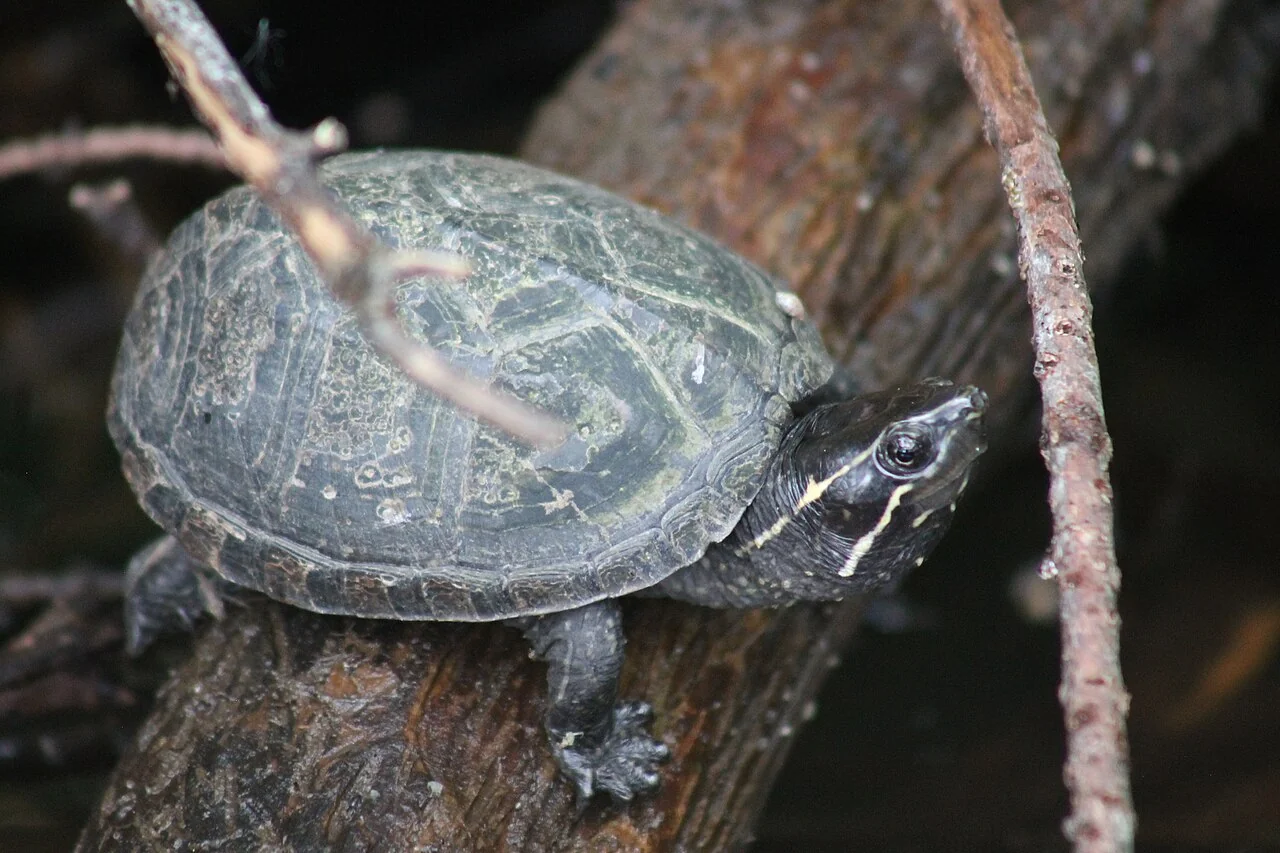
Provide water space and accessible resting places
The water area needs room for movement and furnishings that suit the turtle’s swimming behaviour. Musk turtles often forage along the bottom. Shallow areas where they can extend their head above water, together with accessible routes upwards, help them use the enclosure.
Wood and other structures should be firmly secured. Avoid gaps where a turtle could become trapped. Access to the surface needs particularly careful assessment for young, weak or mobility-impaired animals. Water depth should therefore be planned together with the furnishings rather than simply matching the height of the tank.
Read more: Common musk turtle care: tank, food and daily upkeep
Sources for this section
- Musk Turtle Care, reviewed December 2024Royal Veterinary College
- Housing Aquatic TurtlesVCA Animal Hospitals
Make the dry area large enough for the whole animal
The turtle should be able to leave the water completely and rest on a dry surface. A ramp with good grip helps it climb out, and the area must safely support its adult size. An additional shaded retreat provides another option. Secure edges should prevent the land area from becoming an escape route.
A mature female may also require an appropriate nesting area even when no male is present. Its design depends on the species. A small floating platform does not automatically provide enough space or diggable material for laying eggs. Establish this requirement before settling on the final layout.
Sources for this section
- Housing Aquatic TurtlesVCA Animal Hospitals
- Disorders and Diseases of ReptilesMerck Veterinary Manual
Monitor basking and water conditions separately
Heat and UVB should be arranged over the usable basking area so the turtle can warm its whole body. Targets should follow guidance for the species. Values intended for sliders should not be transferred to musk turtles without checking their suitability.
Measure water temperature, basking temperature and UVB at shell height separately. Lamps must be inaccessible to the animal and installed safely away from splashing. Where water heating is required, use equipment robust enough for the turtle and an appropriate protective guard where needed.
Read more: Getting heat and UVB right in a reptile enclosure
Sources for this section
- How to care for a terrapinRSPCA
- Musk Turtle Care, reviewed December 2024Royal Veterinary College
- UVB lighting for reptilesFrances M. Baines, veterinary surgeon; LafeberVet
Understand the biological role of the filter
A filter traps particles and provides surfaces for microorganisms that process waste. Ammonia is converted first to nitrite and then to nitrate. A new system needs time and a suitable food source for these organisms before it can perform that function reliably.
The system should be cycled without a turtle present. A purpose-made ammonium or ammonia source specifically intended for fishless aquarium cycling provides food for the filter bacteria when dosed according to its instructions. A bottled bacterial starter alone does not supply that food. Repeated tests should show that the measured addition is processed and that ammonia and nitrite subsequently become undetectable. Simply running a filter in clean water for two weeks does not demonstrate this capacity. The aquarium setup guide explains the process in more detail.
Read more: Setting up a freshwater aquarium: tank, filter and water
Sources for this section
- How to set up and look after a freshwater tank / aquariumOrnamental Aquatic Trade Association
- How to care for a terrapinRSPCA
Combine water changes with safe equipment handling
An established filter still needs regular partial water changes. Remove uneaten food, test the water and adjust the amount and frequency of changes to the actual waste load. When necessary, gently rinse biological media in removed aquarium water. Replacing all of it at once would remove much of the useful microbial population.
Before working in the tank, disconnect the relevant electrical equipment as instructed. A switched-off heater needs time to cool before the water level drops below it, and pumps must not run dry. Replacement water should be appropriately temperature-matched and treated for chlorine or chloramine where necessary. Restart equipment only at the correct water level and in accordance with its instructions.
Read more: Caring for an aquarium: watch the water, filter and fish
Sources for this section
Organise everyday care and long-term space
Food and waste affect water quality. Suitable foods and amounts depend on the species. Fish sharing the tank may be chased or injured and should not be treated as harmless decoration. Turtles can also compete with one another. Individual housing is workable for many commonly kept species; any shared arrangement needs its own informed assessment.
Dedicated buckets, hoses and brushes make cleaning easier to organise. Clean them away from kitchen areas and wash hands afterwards. Everyday observations should include use of the land area, unimpeded surfacing and the condition of the skin and shell. A sufficiently strong stand and room for the eventual tank size belong in the initial plan.
Sources for this section
- How to care for a terrapinRSPCA
- Reptiles and AmphibiansCenters for Disease Control and Prevention
- Housing Aquatic TurtlesVCA Animal Hospitals
Sources and photo credit
- Musk Turtle Care, reviewed December 2024Royal Veterinary College
- Housing Aquatic TurtlesVCA Animal Hospitals
- Disorders and Diseases of ReptilesMerck Veterinary Manual
- How to care for a terrapinRSPCA
- UVB lighting for reptilesFrances M. Baines, veterinary surgeon; LafeberVet
- How to set up and look after a freshwater tank / aquariumOrnamental Aquatic Trade Association
- Aquarium Cleaning ChecklistAqueon
- M-series aquarium heater instructionsFluval
- Reptiles and AmphibiansCenters for Disease Control and Prevention
Photo: Sternotherus odoratus 284993684.jpg · Dominic · CC BY 4.0. Resized and converted to WebP; scene unchanged.